
Cumberland Projected Versus Actual Release
A projected date is a current calculation, not a promise. In an IDOC record, Projected Parole Date is the expected physical release from prison to parole or mandatory supervised release when that field applies. An actual Parole Date may replace or accompany it after release. Projected Discharge Date usually refers to the later expected end of the IDOC sentence and supervision. These labels answer separate questions.
A county detainee awaiting trial has no sentence-based release date to calculate. A judge may enter a release order, yet jail staff still must complete identification, paperwork, property, medication, and hold checks. For a short county sentence, the Cumberland judgment, custody credit, and sheriff calculation control. IDOC fields do not govern a person who never entered state custody.
Values such as TO BE DETERMINED and INELIGIBLE are legitimate IDOC entries. Do not replace either with a date calculated from the charge name.
Find Cumberland Projected Release Dates
Begin with the last confirmed custodian. The IDOC Individual in Custody Search covers people committed to Illinois state prison and their state-supervision trail. It does not prove an ordinary Cumberland County Jail bond or time-served release. The public search offers last name, IDOC number, or birthdate modes.
- Confirm whether the person is in Cumberland County Jail, IDOC, federal custody, or another agency's care.
- For IDOC, search by IDOC number when known. Otherwise use name or birthdate and match the result by name, number, and date of birth.
- Read Offender Status and Location before any date. Then copy the exact Parole Date, Projected Parole Date, and Projected Discharge Date labels and values.
- Review every sentence count. A single SENTENCE DISCHARGED?: YES entry may coexist with another active count.
- For a Cumberland jail sentence, obtain the judgment and custody-credit findings from the Circuit Clerk and the actual calculation from the sheriff.
- For pretrial custody, check the court order and ask the jail whether release processing or another hold remains.
The most reliable note records the profile access date, IDOC or booking number, exact field label, current value, and agency. IDOC warns that information can change quickly and its database can be unavailable during updates.
Cumberland IDOC Release Date Fields
IDOC's detail page can show front and side photographs, IDOC number, parent institution, Offender Status, Location, Admission Date, parole fields, projected discharge, and sentence counts. The field table below keeps the state-prison path separate from local jail release.
| IDOC field | How to read it |
|---|---|
| Offender Status | Current IDOC category, including custody, PAROLE, or ABSCONDER |
| Location | Institution or supervision location; PAROLE is outside prison but still supervised |
| Projected Parole Date | Expected physical release from prison to parole or MSR, subject to change |
| Parole Date | Actual state prison release-to-supervision date when posted |
| Projected Discharge Date | Expected end of the sentence or supervision, often later than prison exit |
| Sentence discharged | A YES or NO answer for that individual sentence count |
The successful manifest image is tied to the official IDOC search wrapper and projected-release context. Open the current IDOC offender-search page before checking a live profile.
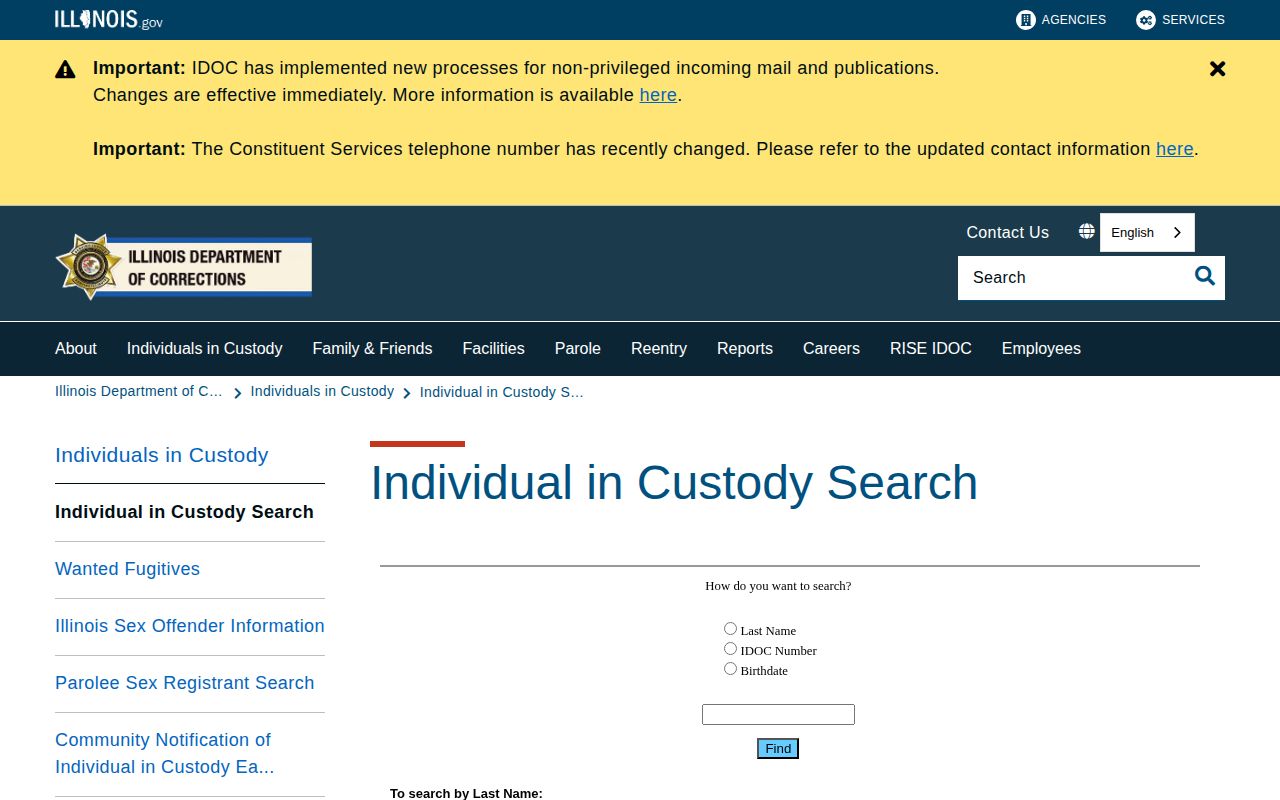
The wrapper leads to the live form, while the selected person's detail supplies the precise date labels.
Note: PAROLE with Location PAROLE shows physical prison release into supervision, not final discharge from the IDOC sentence.
Cumberland Sentence Credit Rules
Illinois sentence credit is governed chiefly by 730 ILCS 5/3-6-3. The rules depend on the conviction, offense date, sentence date, and statutory exceptions. First-degree murder and terrorism categories can require service of the full term. Specified serious offenses generally limit ordinary credit so at least 85 percent is served. Certain categories may correspond to 75 percent, while many other eligible determinate terms can receive day-for-day statutory credit. Natural life receives no credit.
There is no sound rule that all Illinois prisoners serve 85 percent. Program, treatment, education, service, conduct, and discretionary credits may apply under their own authority. Awards are not promises. An earned discretionary award may remain provisional until actual release and can be reduced or withdrawn. IDOC states that a resulting revised projected parole date will appear on the public profile.
A conceptual calculation starts with the court-imposed term, the required service percentage, custody credit, and consecutive or concurrent structure. Sentence-credit awards, disciplinary loss, revocation, recalculation, and later court orders may then change the term. Any MSR period follows under the applicable law. The mittimus, meaning the court's written commitment order, and IDOC calculation control.
Why Cumberland Release Dates Change
Several lawful events can move a projected release. The public profile is only a dated view of the current calculation, so it should be checked again near the expected event.
| Factor | Possible effect |
|---|---|
| Credit award | May move the projected parole date earlier after IDOC posts the award |
| Credit loss or withdrawal | May move the date later |
| Consecutive or concurrent correction | Changes how multiple terms combine |
| Court order or amended mittimus | Can change sentence length or credited custody time |
| Revocation | Can return a supervised person to custody and require recalculation |
| Detainer or receiving agency | May cause transfer at release from one custodian rather than community release |
| Administrative processing | Can make actual departure later than the legal authorization |
A detainer is a request by another authority for notice or continued custody. It does not always change the sentence date, but it can change where the person goes when one custodian releases them. Ask for the receiving-agency field instead of assuming return to the community.
Cumberland Jail Release Calculations
County jail calculations are not copied from an IDOC public profile. The local judgment may include jail credit, and the sheriff must apply the controlling order and lawful rules. Inputs can include the mittimus, continuous custody, bond-release intervals, statutory tables, and time lost or awarded. The IDOC misdemeanor and jail-credit directive shows the kinds of inputs involved, but it is not proof of a Cumberland County policy.
No Cumberland-specific weekend-release rule or local good-time policy was located. Do not infer one from another Illinois county. Ask the Cumberland Circuit Clerk for the judgment, sentencing order, custody-credit findings, and later modification. Ask the sheriff for the jail calculation and completed release time. A court order proves legal authority, while the sheriff record proves physical departure and whether another agency took custody.
For a calculation dispute, provide the case number, booking number, order, custody dates, and exact field in question. Request the agency's correction process. A general web estimate should never override the official calculation.
A pretrial stay requires a different reading. A person held before judgment may have a court hearing or release condition, but not a sentence-based projected release date. The Office of Statewide Pretrial Services can supervise a person after the jail exit through court-ordered check-ins, testing, curfew, or electronic monitoring. That supervision does not turn the jail departure into an IDOC parole date. Read the Cumberland court order for the conditions, then use the sheriff record for the time staff completed the physical release.
The jail inspection adds useful limits to any estimate. Staff must confirm identity and record the date, time, and authority for release, return property, document medication released with the person, and complete any receiving-agency handoff. Those steps explain why an order entered on the docket and the actual exit can have different timestamps. No official source gives a fixed Cumberland release hour. For a pending order, ask the sheriff whether processing is complete instead of treating the hearing time as the release time.
Cumberland MSR and Discharge Dates
Mandatory supervised release can extend beyond the day a person leaves the prison building. Under 730 ILCS 5/5-8-1(d), the term depends on the offense and class, with important exceptions. General current terms described in the research include 18 months for Class X, 12 months for Class 1 or 2, and six months for Class 3 or 4. Specified offenses can have different or longer terms. Those figures are not a calculator for a named person.
Read the judgment and current statute for the exact conviction and date. The Projected Parole Date may answer when physical prison release is expected, while Projected Discharge Date may answer when the later sentence and supervision trail is expected to end. Early final discharge is a separate official decision. Until the record supports that event, do not convert release to MSR into full discharge.
A state profile can also contain several sentence counts from different cases or counties. Review each count and its discharge answer. One completed count does not erase an undischarged count, and a Cumberland commitment may run with or after another term. IDOC records and the controlling judgments are needed to resolve that structure.
Confirm Cumberland Release Dates
Near an expected date, check the same official source again. For IDOC, record Offender Status, Location, actual or projected parole field, projected discharge, and each sentence count. For Cumberland County Jail, call 217-849-2571 and request the completed date, time, authority, disposition, and receiving agency. A pending court order is not the final jail timestamp.
Illinois VINE can provide a source-fed release or transfer notice. Registration does not replace the underlying record, but it can flag a change that should be checked. The Cumberland County VINE inmate check covers identity matching and alert registration. For a final IDOC record, FOIA can seek admission, release, discharge, sentence calculation, and decision materials.
Release and discharge must remain distinct. A person can leave prison on MSR and have a later projected discharge. An ABSCONDER status is not completion. A transfer from Cumberland County Jail is a release from that facility, but not proof of freedom. Precise labels prevent those errors.